This doc is coming soon. Our documentation is currently undergoing maintenance. If you need support or have any questions, please reach out to support. We’re here to help! In this tutorial we’ll walk you through the following steps to setup your Stiddle Pixel with your Shopify store.

Installing The Stiddle Pixel With Shopify

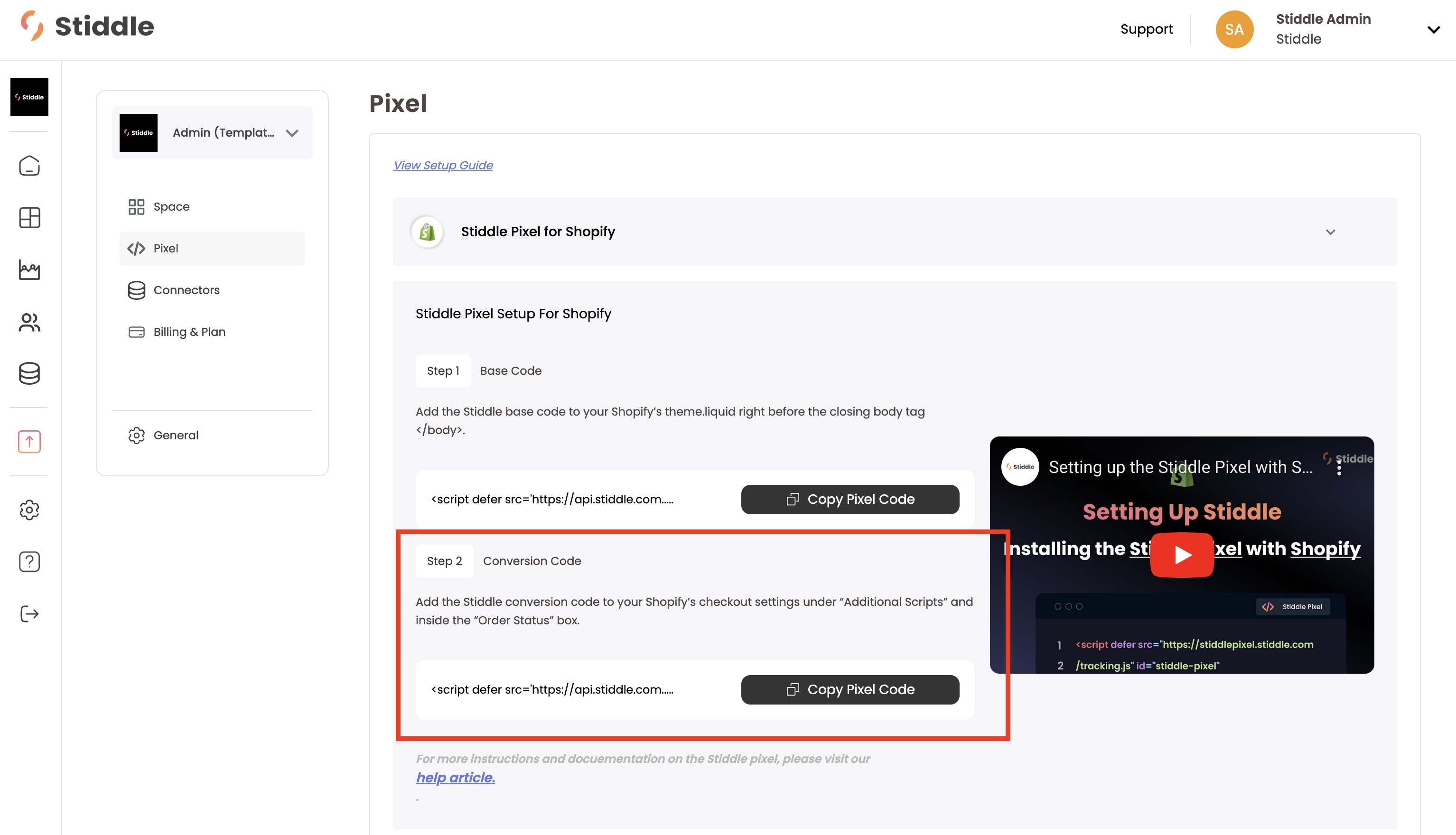
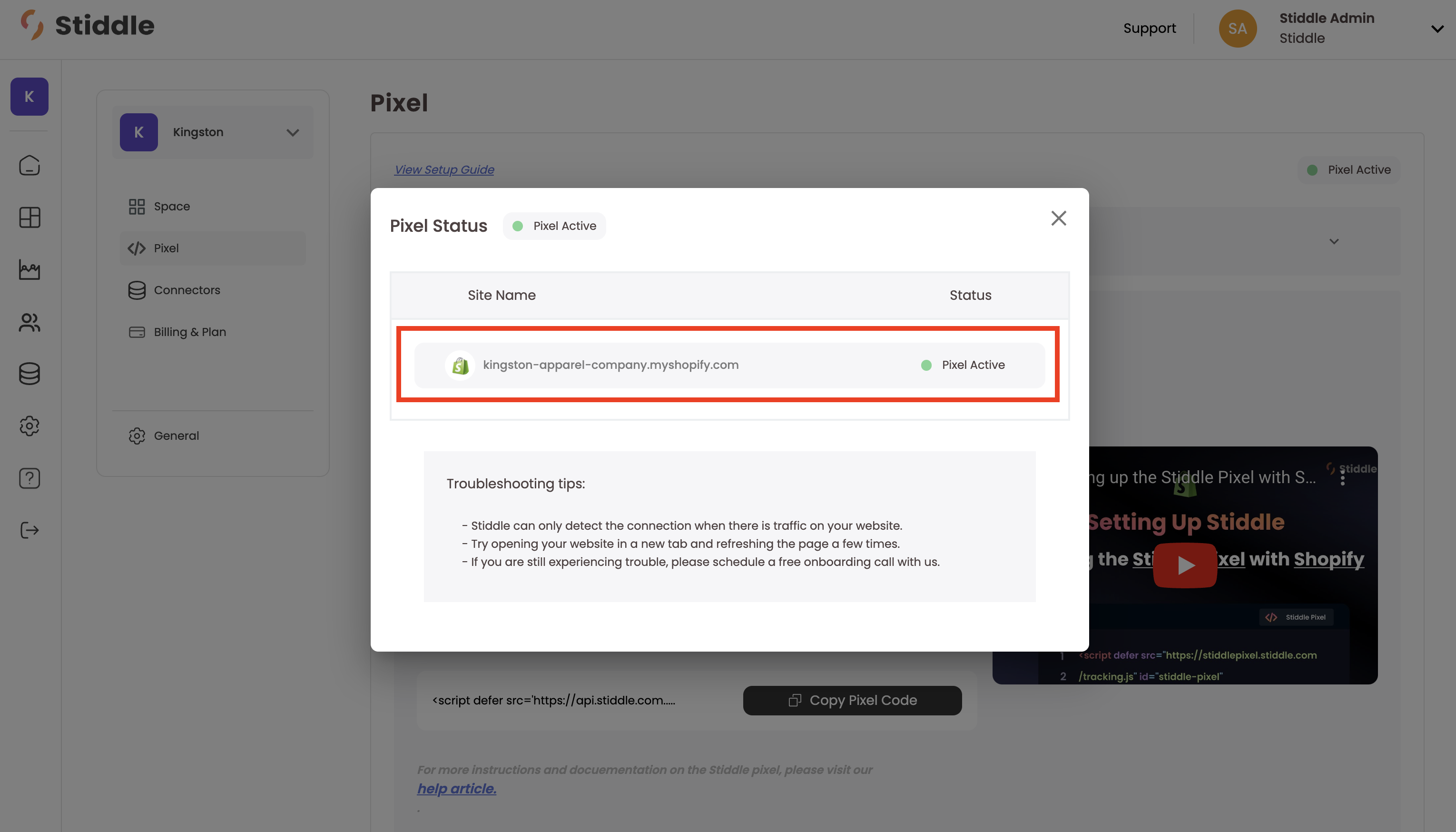
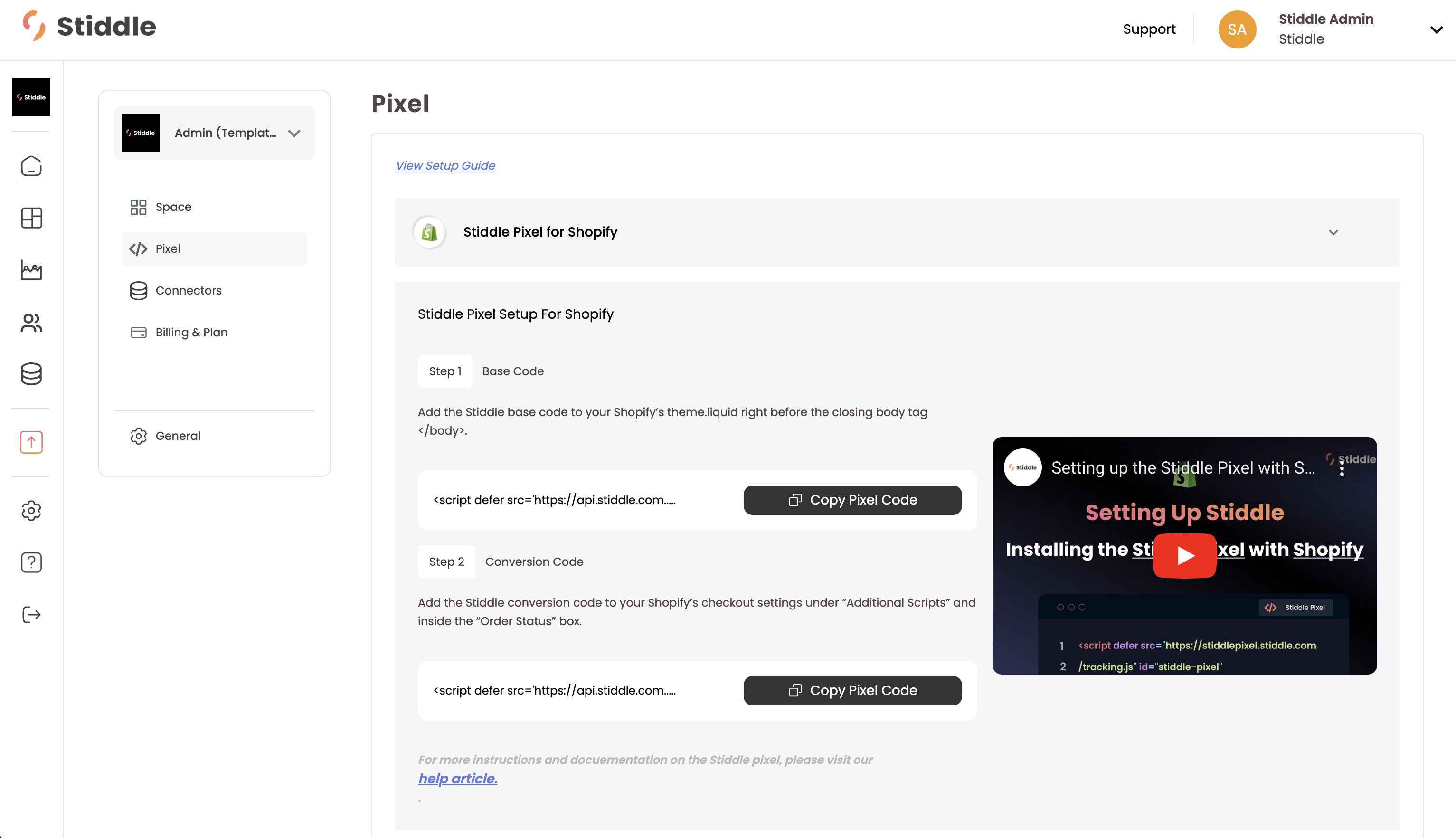
The Stiddle Pixel helps track and identify visitors from your site. This is required for accurate attribution and identity resolution. Please make sure to follow the steps exactly as they are described below. If set up incorrectly, Stiddle won’t be able to track and identify your customers - resulting in inaccurate ad tracking. At any point during setup you face issues or have questions with setup, please don’t hesitate to contact one of our support team members - we’re here to help! Getting Started To find your Stiddle Pixel, select the workspace you want to enable and set up the pixel for. Once selected, navigate to the left hand navigation, select “Settings” and select “Pixel”. Screenshot2024 02 27at7 28 09PM 8v6py Dro Start by copying the “Base Code” of the Stiddle Pixel and navigate to your Shopify store dashboard. Select “Online Store” from the left hand navigation, then navigate to “Themes”. Select the three dot menu, then select “Edit Code”. 0 Screen+shot+2023 06 27+at+3 44 14+PM 775db05b 09dd 47ac B77b 876c89bac7d8 M3zgd 7W Once in the Shopify code editor, navigate to the left hand menu and select “theme.liquid” - this is stored under the “layout” folder.  Scroll down to the bottom of the page and paste your copied Stiddle Pixel code into the file right above the closing </body> tag. 0 Screen+shot+2023 06 27+at+3 44 39+PM 2dbf5cd0 1d4c 4e1c A785 Be06dd66a110 Au Am MQCI Make sure to save your changes. Navigate back to your Stiddle Pixel settings, copy the “Conversion Code” - from step 2.  Screenshot2024 02 27at7 29 04PM Fpek6zq G Go back into your Shopify dashboard, select “Settings” - found on the left hand navigation. Then select the “Checkout” tab.  0 Screen+shot+2023 06 27+at+3 45 36+PM 23e2e944 F93e 40e4 8536 D462fa8426f0 2BWMSJKC 0 Screen+shot+2023 06 27+at+3 45 54+PM 9327f9dc Cdf6 44f1 9565 1e4a8acc4881 Mp K4lykh Scroll down to the “Order Status Page” section and paste your Stiddle Pixel Conversion Code, under “Additional Scripts”. Select “Save” to save your changes. 0 Screen+shot+2023 06 27+at+3 46 21+PM Bfadd516 F042 48b0 8f8e Afe05c8a3589 8g Ph Qm Rb That’s it! Your Stiddle Pixel is not installed on your Shopify store. To verify it is working and installed correctly, navigate back to your Stiddle Pixel settings page to see if the pixel status is set to “Pixel Active”.  Important Please note that the Stiddle Pixel status will only change to active status after it has identified a new visitor on your Shopify store. To test this, go into an incognito or private browser and visit your Shopify store and click around to a few pages. Navigate back to your Stiddle Pixel settings, refresh the page, and check to see if the status is now set to active. If you are unsure of which Shopify store you have connected to Stiddle and want to see where the traffic is coming from, select the “Pixel Status” button to find more information on the status and troubleshooting. Screenshot2024 02 27at7 30 03PM H Ect3x1l Screenshot2024 02 27at7 30 30PM J B6qqz U3
Connecting Shopify to Stiddle

Connect Shopify to Stiddle to start syncing your Shopify data for a single source of truth with purchase tracking, attribution, identity resolution, and analytics. 
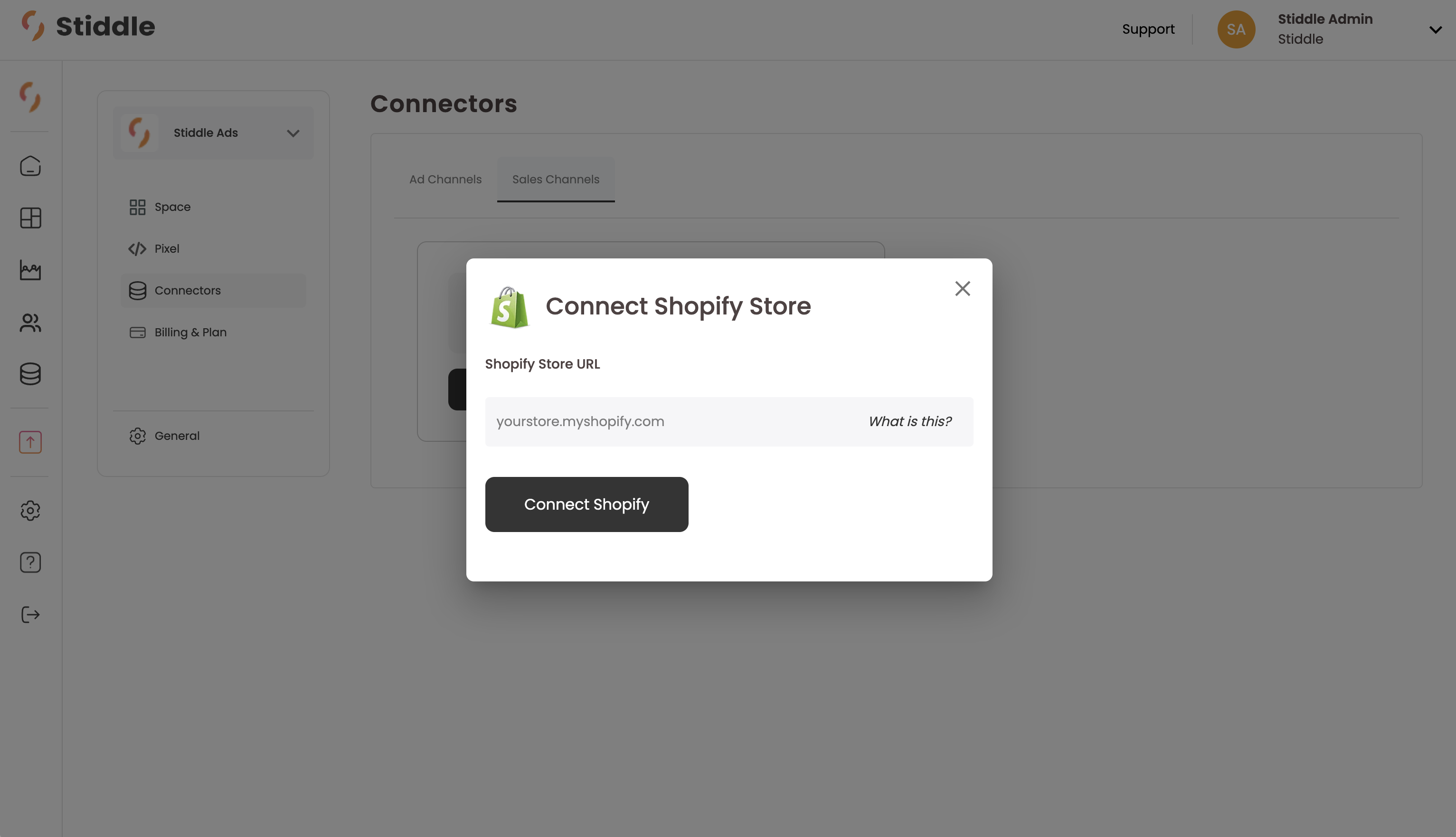
Connecting The Shopify App To connect Shopify, select the workspace you want to connect to. Once selected, navigate to the workspace settings and select “Connectors”.  Select “Sales Channels”, find Shopify, then select “Connect To Stiddle”.  Screenshot2024 02 27at6 18 55PM 8i Sn I2rl Paste your Shopify store URL, this is the URL Shopify provides you when creating a new Shopify store - this is NOT your custom domain. Not Correct:
mystore.com
Correct:
mystore.myshopify.com
Follow the instructions on the screen to complete the integration with Shopify and Stiddle. Make sure to provide access to all of the required permissions requested by Stiddle. Syncing Past Customer Orders Next you’ll need to sync all of your previous order data from Shopify, there are a few ways to accomplish this. Shopify stores with large order history (over 2,000 orders) will need to upload orders manually using a CSV ~ see method two below. If you have less than 2,000 orders in your Shopify store, method one will sync automatically without the need for any manual CSV upload. We don’t recommend skipping this step, skipping this step will restrict the use of Shopify metrics in your Analytics Dashboards and Profiles.
  1. Syncing Past Customer Orders - Under 2,000 Orders
<GIF> 2. Uploading Past Customer Orders Using CSV - Over 2,000 Orders
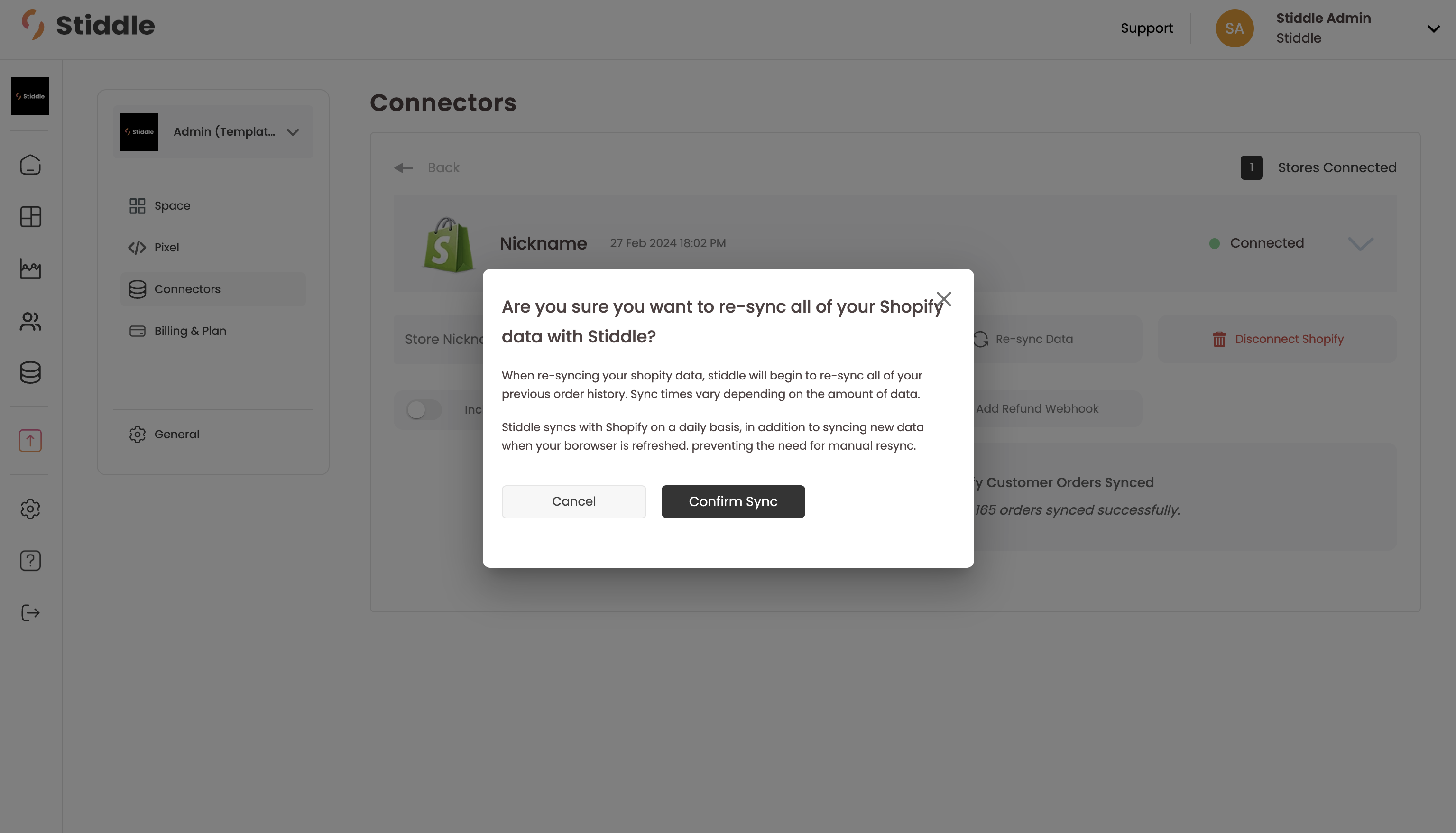
Setting Up Order Return Tracking Use Stiddle’s refund webhook to track Shopify order returns in Stiddle. This allows you to track and update refunds in Stiddle Profiles. Stiddle will also automatically calculate ROAS, CV, net profit, and other attribution related metrics using the refund webhook. The refund webhook is very easy to setup with Shopify. Follow the  below video for setup instructions.  <GIF 2> Important Note Please note that only one Shopify store can be connected per Workspace. If you need to track additional Shopify stores, please create a new workspace then connect and set up Shopify tracking accordingly. Re-syncing Shopify At anytime you can re-sync Shopify data with Stiddle, without disconnecting the integration. Remember that when re-syncing your Shopify data, Stiddle will begin to re-sync all of your previous order history. Sync times vary depending on the amount of data. Stiddle syncs with Shopify on a daily basis, in addition to syncing new data when your browser is refreshed. This prevents the need for frequent manual re-syncs. That being said, we don’t recommend doing this often.  Screenshot2024 02 27at6 46 44PM I7d9f9m W